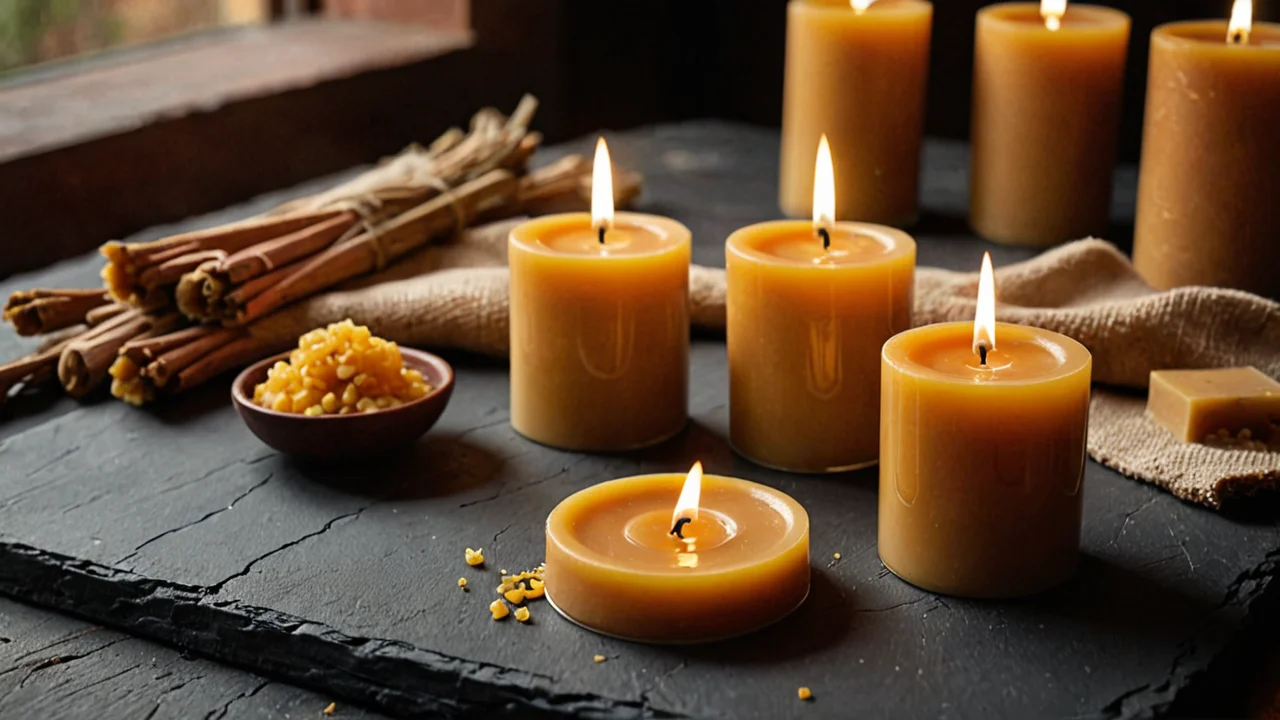
The biggest mistake novice chandlers make when incorporating beeswax is assuming that because it smells natural, it can be treated with the same high-heat processing tolerances as paraffin or soy; in reality, beeswax has a distinct burning profile, often leading to tunneling and requiring specific temperature management during the melt phase.
Beeswax Properties
When working with pure beeswax, you are dealing with a material that offers incredible structural integrity and a naturally appealing color, but its physical properties necessitate adjustments in your typical candle formulation. Unlike some waxes that soften rapidly or require extensive additives to reach optimal fluidity, beeswax melts at a specific temperature range and holds its structure well, which is excellent for creating sturdy pillar candles or highly scented votives. However, you must be aware of the difference between its flash point—the lowest temperature at which it produces enough vapour to ignite in air in the presence of an ignition source—and its melting point. While manufacturer safety data sheets list a flash point ≥250 °C for general candle wax and autoflammability approximately 350 °C, always consult the specific Safety Data Sheet (SDS) provided by your beeswax supplier; this document is critical as it details the exact physical and chemical properties, including required handling precautions. Furthermore, because beeswax has a higher natural flash point than some additives might suggest, extreme care must be taken when mixing components to ensure no localized overheating occurs.
Understanding these inherent characteristics means that while it can carry scent wonderfully—often providing a subtle honey-like note—it requires precise temperature control throughout the pouring process. Overheating beeswax, particularly if scented with essential oils or fragrance blends, can degrade its natural waxy components and compromise the final burn quality.
Fragrance Incorporation
When moving into scenting, it is crucial to remember that your total product safety profile depends on every component, especially fragrances. Never rely on the general flash point of the wax alone; you must check the specific fragrance flash point of your chosen blend or essential oil.
The industry guidance is very clear: fragrances with a flash point below 60 °C should be avoided in candles because they significantly increase candle fire risk. If you are using multiple scent sources, including both pure fragrance oils and natural essential oils, every single component must meet this safety threshold. The principle here is additive risk; even if your wax has a very high flash point—for example, one tested at >399 °F (or >190 °C) via the COC method—introducing low-flash-point scent materials can lower the overall safety margin of the finished product. You must always treat the SDS for the final candle as if it contains the most hazardous component.
When blending, remember that incorporating essential oils, while desirable because they are natural, does not automatically make them safe; you are dealing with volatile organic compounds (VOCs) that need to be assessed by their specific flash point. If you plan on using a blend of various oils and fragrances, it is best practice to test the final mixture’s safety data sheet rather than relying solely on individual component sheets.
Optimal Pouring Temperatures
The temperature at which you pour your wax dictates everything from crystal clarity to scent throw. Because beeswax has a higher melting point and unique viscosity compared to commodity waxes, following generalized pouring temperatures is insufficient. You need to establish the optimal window based on your specific blend of beeswax and additives.
While there isn't one fixed magic number that works for every combination, general industry practices suggest that allowing the wax bath temperature to cool down significantly before pouring can help reduce shrinkage and minimize sink marks. However, if you pour too cold, the crystalline structure of the beeswax may not fully solidify around the wick, leading to poor adhesion and a weak draw.
For beginners wondering what is needed for candle making, beyond your molds and wicks, you need accurate thermometers—digital ones that measure temperature precisely in Celsius or Fahrenheit—and reliable heat sources (like double boilers) capable of maintaining stable heat. The consistency of the pour is more important than the exact degree; ensure that the entire volume of wax is at a uniform, safe working temperature before pouring.
Safety and Handling
Candle making, while profitable for many artisans, involves working with high temperatures, volatile materials, and open flames. Safety cannot be overstated, as mistakes regarding heating methods or material compatibility are dangerous. Understanding the definitions of flash point and autoignition temperature is not merely academic; it dictates your workshop setup.
The flash point defines when a liquid produces enough vapour to ignite in air with an external spark—this governs your working heat limits. The autoignition temperature, conversely, describes the temperature at which the material will spontaneously ignite without any external flame or spark; safety data sheets for candle waxes may list this value to indicate the absolute upper limit of safe heating during melting, and you must never exceed it.
Always use indirect heat sources, such as a double boiler setup. Never attempt to melt beeswax directly over an open flame. Furthermore, when working with multiple components—for instance, adding essential oils or fragrance blends—always stir gently and slowly once the required temperature is reached. Vigorous stirring can introduce air pockets that affect the final burn rate and can also increase localized heat build-up, raising safety concerns.
Business Considerations
For those considering making this a sustainable venture, while candle making itself is not inherently difficult—it has a relatively low barrier to entry in terms of equipment (molds, wicks, wax)—the market is highly saturated. To succeed and make it profitable, you cannot rely solely on the "natural" appeal of beeswax; your differentiation must come from quality control and unique experiences.
A common mistake among new sellers is underestimating the cost associated with safety compliance and material sourcing. When creating a business plan, factor in premium ingredients (like high-quality pure beeswax), professional testing protocols to ensure fragrance components meet flash point guidelines, and the costs of excellent presentation. The market rewards consistency and demonstrable quality. If your wax blend has structural issues due to temperature mismanagement, or if your scent throw is weak because you used low-grade essential oils instead of professionally blended fragrance compounds, customers will notice.
Furthermore, while many people wonder about the difficulty level, mastering beeswax requires patience. It demands adherence to strict thermal protocols and a deep understanding of how its molecular structure reacts to heat transfer compared to other waxes available on the market. Treat each batch as a scientific experiment until you have repeatable success.
Tempering beeswax with softer waxes without wrecking the scent
Melt the hard wax first and add the soft one last, off the heat, because beeswax has the highest melt window in the pot and adding coconut or soy to a cold double boiler just means you reheat everything and lose your fragrance headroom. Bring the beeswax up slowly in indirect heat until it is fully liquid and clear, pull the insert out of the water, then stir in the softer wax and let residual heat carry it. If you dump beeswax into already-melted soy, the beeswax sinks and sits on the bottom of the pot in a stubborn puck that scorches against the metal before it dissolves.
You notice the failure at the pour, not in the pot: a blend that wasn't stirred to homogeneity sets with a mottled surface and a faint ring of harder wax at the top edge, and that candle will tunnel on one side and burn clean on the other. Stir in a slow figure-eight for longer than feels necessary, then stir again before each individual pour, because the harder fraction starts to separate the moment the pot stops moving.
Adding soft wax lowers the effective working temperature of the blend, so your fragrance addition point moves too. Check the SDS on every scent you intend to use and keep low-flash-point materials out of the recipe entirely — the guidance to avoid fragrances with a flash point below 60 °C is not a suggestion, and a soft-wax blend gives you no extra tolerance for a volatile oil. The trade-off is real: more soft wax buys you better scent throw and less brittleness, but it costs you the structural rigidity that made you reach for beeswax, so pillars suffer and containers forgive.
Why your beeswax candle tunnels, and the wick fix that actually works
Beeswax needs a larger wick than the same diameter in soy, and the tunneling most chandlers blame on pour temperature is usually an undersized wick. Beeswax has a high melt point and a viscous melt pool, so a wick that performs in a soy pillar of the same size will drown — you get a small flame, a narrow well, and wax climbing the inside wall. Size up, then test the actual candle rather than trusting a wick chart built around softer waxes.
Do the test properly: burn a cured candle in a draft-free room in sessions long enough for the melt pool to reach the edge, and note how many sessions it takes. If the pool never reaches the wall before the flame starts guttering, the wick is too small; if the flame smokes, flickers tall, or the pool hits the edge within the first session on a wide pillar, it's too big and you'll get a blowout at the base. The mushrooming you see on a beeswax wick is normal and not a sign of oversizing by itself — trim to roughly a quarter inch before each burn and reassess.
The pour sequence matters less than the wick, but it still bites. Pouring hot into a mold gives you sink holes and shrinkage at the top; pouring too cool gives you poor wick adhesion and a weak draw, which reads to the customer as a candle that won't stay lit. Warm the mold, pour at a uniform temperature across the whole batch, and top off the shrink crater after the candle has fully set rather than chasing it while the center is still liquid. A second pour over a still-warm center just creates a seam that cracks later.
Reading the SDS before you heat anything
Pull the Safety Data Sheet for your specific beeswax and your specific fragrance before the pot goes on, and write the flash point and autoignition temperature on a card taped next to your melter — not because the numbers are close to your working range, but because they tell you where the hard ceiling is. Manufacturer sheets for candle wax list a flash point ≥250 °C with autoflammability around 350 °C, and paraffin-based products run a flash point above 204 °C (400 °F) with an autoignition temperature near 750 °F. Your double boiler will never approach those numbers in normal use, which is exactly why the danger is misuse: a pot left dry, a direct-hotplate shortcut, or a wax batch reheated over and over until it scorches.
Understand what the two numbers measure so you don't confuse them. Flash point is the lowest temperature at which the material gives off enough vapour to ignite in air with an ignition source; autoignition temperature is where it lights with no flame or spark at all, and that is the value that caps how hot you ever allow the melt to get. Water in the bottom of a double boiler keeps the wax bath pinned well below either figure — that is the whole point of the setup, and it's why you never walk away from a dry insert.
Fragrance is where the sheets actually change your recipe. A scent with a low flash point raises the fire risk of the finished candle, and industry advice is to avoid anything below 60 °C outright. When you blend several oils, treat the finish as though it carries the most hazardous component and test the combined mixture rather than trusting each sheet in isolation. The cost here is time and possibly reformulating a scent you love; the alternative is a candle whose safety profile you can't document, and that is not a product you want to sell.